
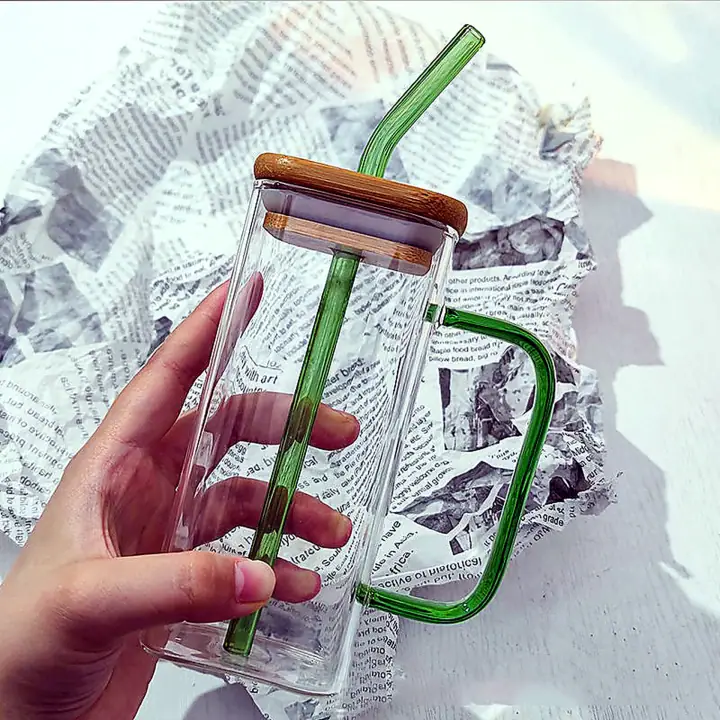
This article uses a typical quotation situation our team regularly sees. It is not presented as a named customer case.
Some buyers are surprised when we do not answer “best price?” with a number in the first message.
But we have also seen what happens when a product such as our DB0004 400ml mason jar glass mug is priced before the finished order is understood. Its borosilicate body may be fixed, while the lid, straw, handle color, logo and packing are still open.
The first quotation looks low. Then the logo is added. The box is added. The lid turns out to be separate. The buyer asks for a barcode, a stronger insert or different carton marks. Sample work begins, and the product being discussed no longer matches the original price.
At that point, the buyer feels that the supplier has increased the price. The supplier feels that the buyer has changed the order. Usually, both sides are looking at incomplete information.
We would rather slow down the first quotation than create that argument later.
The product behind the price discussion
DB0004 is a 400ml borosilicate mason jar glass mug. Our current product record lists logo, lid, straw and handle color as customization points. Packing can follow a custom retail box, an e-commerce packing route or an export carton.
For this existing model, the current planning baseline is an MOQ starting from 2,000 pieces and a typical sample lead time of 7–15 days. That baseline gives the buyer a useful place to begin. It does not mean every combination of lid color, straw, logo and box can be divided freely inside the same quantity.
Review the DB0004 400ml mason jar glass mug
The lowest number often describes the emptiest version of the product
Imagine three cups on our sample table.
The first is the DB0004 400ml glass body prepared with a standard accessory direction and ordinary export packing. It has no custom logo or retail box.
The second uses the same 400ml body, with a confirmed lid and straw combination, selected handle color and a one-color logo.
The third uses the complete mug, lid and straw as an e-commerce-ready item with an individual printed box, barcode, protective structure and shipping marks.
From a distance, a buyer might call all three “the same glass cup.” From a quotation perspective, they are three different products.
The lowest price usually belongs to the first version because it contains the fewest decisions and the simplest scope. If the buyer intends to sell the third version, the first price is not a useful benchmark.
This is why we ask a direct question before quoting: what exactly should arrive at your warehouse?
The answer should include every piece the customer will receive, not only the glass body visible in the reference photo.
We begin with the product that already exists
The glass body still matters. We first check whether DB0004's 400ml mason-jar format is the right starting point, whether the buyer would be better served by another current lid-and-straw cup or whether a new development is genuinely necessary.
An existing cup allows us to work from a known shape and sample. A new shape may require drawings, tooling and trial work. Even among existing models, weight, capacity, handle design and wall structure can change the production route and packing requirement.
Before discussing price, we ask what the buyer needs the customer to notice: a comfortable rim, the 400ml capacity, the colored handle or the complete lid-and-straw presentation. That priority tells us whether DB0004 is the right starting model.
Quantity is not only the total number on the purchase order
A buyer may tell us the DB0004 order is 6,000 pieces. That sounds clear until we learn that it contains three handle colors, two logo colors and different boxes for two markets.
Production quantity must be reviewed by model, size, color and decoration. Packaging can create additional splits if different markets require different boxes or labels.
Six thousand identical DB0004 mugs are not the same production plan as six thousand pieces divided among six handle-and-logo combinations.
The divided order requires more artwork checks, more packing instructions and more opportunities for the wrong item to enter the wrong box. It may also leave each individual SKU below the practical quantity for its decoration or packaging.
For a first collection, we often suggest putting more quantity into the strongest one or two models. This gives the buyer a better chance to test the product without creating slow-moving inventory across too many sizes.
A logo is not one line called “printing”
The next part of the quotation is decoration.
We need to see the artwork on the DB0004 body. The number of colors, logo size, position and surface shape all matter. A small mark on the straight glass area is different from a large design that approaches the colored handle or wraps around the body.
We also need to know what the buyer expects from the sample. Is a digital placement enough for internal selection? Does the buyer need a physical decorated sample? Must the logo be approved by a retailer or brand team before bulk production?
If decoration is quoted as a vague line item, the cheapest method may be assumed even when it does not match the design.
We state the decoration route and what the sample will prove. If the artwork changes later, we can explain which part of the cost or timing changes with it.
Packaging is where many low quotations stop being low
Packaging is often treated as something to decide after the cup price is accepted.
From our side, that sequence creates risk.
The package determines how the rim, body and handle are supported. It affects inner quantity, export carton size and the amount of material used. It also determines whether the finished product is ready for restaurant distribution, retail display, gifting or parcel delivery.
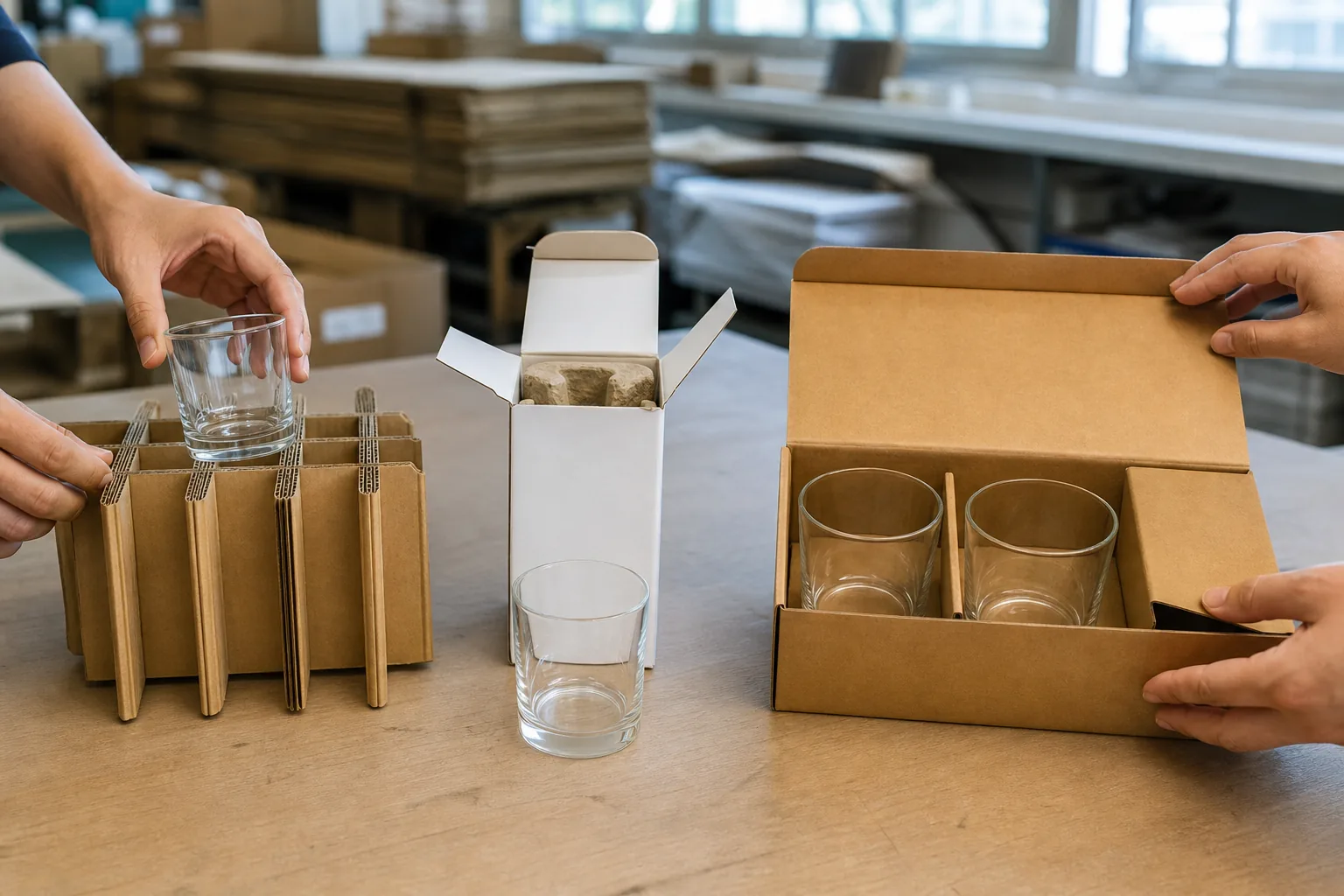
Editorial illustration. It demonstrates packaging choices and does not claim to show a named customer order.
On our table, we may review three possible packing routes.
The first uses practical separation inside an export carton. It may suit a buyer who will redistribute DB0004 mugs in bulk and does not need a consumer-facing box from us.
The second places each complete DB0004 mug, lid and straw in an individual retail carton with fitted protection. It adds material and packing work but may suit store or online handling better.
The third follows an e-commerce packing route. Now the box must hold the mug, lid and straw as one complete SKU, keep the glass and accessories in position and carry the buyer's artwork, barcode and labels.
These are not cosmetic differences added after the “real product” is priced. Packaging is part of the real product.
When a buyer asks us to reduce cost, packaging is also one of the areas we review. Sometimes a simpler existing box structure can protect the cup without weakening the offer. Sometimes the sales channel requires stronger individual protection, and reducing it would only move the cost into damage claims and replacements.
The cheapest box is not useful if it does not match the journey of the cup.
Accessories create another layer of price and responsibility
DB0004 is exactly why accessories cannot be treated as an afterthought. The sellable item may include the 400ml mug, lid and straw, with the handle color forming part of the visual offer.
Each item must be specified and matched. A lid has a material, diameter, finish and sealing expectation. A straw has a length and packed position. A sleeve must fit the glass body. A gift-set insert must hold every part without allowing hard surfaces to collide.
We need to know whether the buyer accepts the existing DB0004 accessory direction or requires a different lid, straw or color. A standard combination may follow the existing project route. A special color or changed component can alter setup, quantity allocation and sample approval.
When accessories are missing from the first RFQ, a low cup price can create the impression that the finished set will be inexpensive. Later, the accessory cost appears as an increase even though it was never included in the original scope.
We therefore ask buyers to describe what the consumer opens, not just what the product photo shows.
Quality requirements should be agreed before they become complaints
Buyers sometimes ask us to quote “good quality.” We cannot put that phrase into a useful inspection instruction.
We need to understand which points matter for the product and market. These may include rim condition, obvious cracks, logo position, lid fit, box condition, labels, carton quantity or agreed appearance limits.
The buyer may also have a retailer checklist or third-party inspection requirement. If so, we need to see it before production planning, not when cartons are already closed.
Inspection work, sorting requirements and documentation can affect the order scope. More importantly, early agreement prevents one team from accepting a condition the other team considers a defect.
We do not invent a perfect-glass promise. Glass production has variation. Our responsibility is to identify what will be checked, what reference will be used and what must be corrected before shipment.
A quotation that ignores this discussion may be cheaper on paper, but it leaves the buyer without a shared release standard.
Destination and trade term change what the price includes
The same product can be quoted under different commercial boundaries.
An EXW discussion is not the same as a quotation that includes delivery to a port, warehouse or another agreed handover point. Destination also affects carton marks, packing decisions and the information needed for freight planning.
We ask for the country even when the buyer does not yet need a freight quote. It helps us understand label expectations and any test or document requirements the buyer needs us to review.
We also state what the quotation excludes. A clear exclusion is better than allowing the buyer to assume every future cost is included.
Price comparison only works when the suppliers are quoting the same product under the same trade term.
We prefer to give buyers two workable routes
When cost is the main concern, we do not simply remove items until the quotation looks attractive.
We try to identify two workable routes.
One route may use DB0004 with a standard lid-and-straw direction, one handle color, one logo color and export packing. It gives the buyer a clearer starting point.
The second route may use the same 400ml mug with multiple handle colors, a finished retail box, barcode and the protection needed for e-commerce handling.
The buyer can then see which feature changes the scope. This is more useful than receiving one unexplained total and asking us to reduce it by a percentage.
Sometimes the final decision is to simplify the first order and add custom packaging on the repeat order. Sometimes the box or lid is central to the product, so the buyer keeps it and reduces the number of SKUs instead. There is no universal answer, but there should be a visible reason for the decision.
Our role is to show the trade-off. The buyer decides which part creates value in the market.
What we need before giving a price we can defend
A useful glass cup quotation normally starts with:
- DB0004 as the starting SKU, or a reference showing why another body is needed
- Confirmation that 400ml is suitable
- Quantity per handle color and logo version
- Existing mold or new design preference
- Logo artwork and decoration idea
- Lid and straw specification, color and packed position
- Individual packing or set structure
- Sales channel
- Destination country
- Required timing
- Trade term if already decided
- Inspection or retailer requirements
You do not need to know every answer. Tell us which details are fixed and which are open to recommendation.
If the target cost matters, share it as a planning constraint. We can then check whether an existing model, simpler decoration, different pack structure or smaller SKU range can bring the product closer to that target.
We would rather explain that a target is difficult than quietly remove part of the finished order from the quotation.
Questions buyers ask before comparing quotations
Why can a supplier not confirm the final price from one photo?
A DB0004 photo shows the 400ml mug, lid, straw and colored handle, but it does not confirm which versions belong in the order. Quantity per color, logo, accessory details, packing, inspection requirements, destination and trade term can all change what is included.
How should we compare quotations from different glass cup suppliers?
Give every supplier the same finished DB0004 scope and compare assumptions line by line. Confirm the 400ml body, quantity per handle color, logo, lid, straw, packing method, quality checks and trade term. A cup-only quotation cannot be compared with a complete e-commerce item as if both were identical.
Does custom packaging always make the project expensive?
It adds material and packing work, but the answer depends on the structure. We can often review an existing box style or simplify print details. The important point is not to weaken protection that the retail or delivery channel genuinely needs.
Should a buyer share a target cost?
Yes, when it is treated as a planning constraint rather than a finished quotation. It helps us review the cup model, decoration, pack structure and SKU count. We will state what must change to approach the target instead of silently removing part of the order.
A useful price is one that survives the next conversation
The best quotation is not the one that wins the first comparison and changes after every email.
It is the one that still makes sense after the buyer confirms the logo, box, accessories, inspection points and destination.
That is why we sometimes appear slower in the first reply. We are checking whether the number describes the product the buyer actually wants to receive.
If you are comparing glass cup suppliers, send each one the same product scope. Ask what is included. Ask which mold, decoration and packing method the price assumes. Ask whether the quantity is per SKU. Ask what sample will be approved before bulk production.
Then compare the answers, not only the final line.
If DB0004 fits your product idea, send us the quantity per handle color, logo, lid-and-straw requirement, packaging direction and destination. We will separate the basic export route from the retail or e-commerce route so you can see which decision changes cost.
That may not produce the fastest “best price” message.
It gives you a quotation you can actually use.