
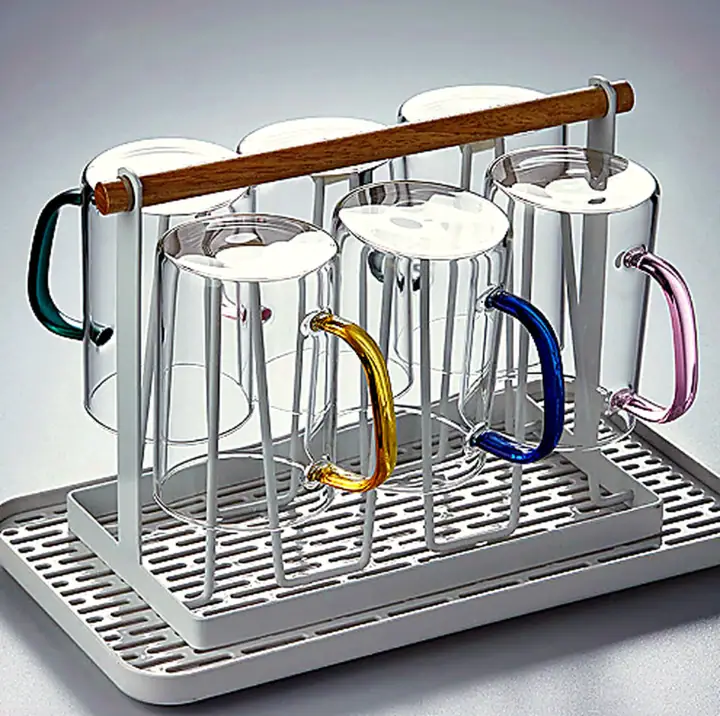
This article describes a typical inquiry pattern our team handles. It does not represent a named customer or claim confidential project details.
The message often arrives when our working day has barely started.
There is one photo attached. It shows a clear glass cup with a colored handle. Under the photo, the buyer has written a short question:
“Can you make this? Please send your best price.”
We understand the question. The buyer has found a product that fits a new collection, a café program or a retail idea. At that moment, the picture feels like the project. The shape is visible, the cup looks simple, and asking for a price seems like the natural next step.
From our side of the table, however, the picture is only the beginning. A reference like this immediately makes us think of DB0003, our 300ml borosilicate glass cup with a colored handle. That gives us a real starting product, but it does not yet give us a complete order.
We can see that the product is a glass cup. We may be able to estimate whether it was pressed, blown or made from borosilicate tubing. We can study the handle, rim, base and general proportions. But we still do not know what the buyer intends to sell.
We do not know the capacity. We do not know whether the buyer needs the exact shape or only a similar feeling. We do not know if the cup will hold hot coffee, iced drinks or water. We do not know whether the final product includes a lid, straw, logo, color box or two-piece gift set.
If we answer with a number immediately, that number will probably describe a different order.
The real product we put on the table first
For this type of inquiry, we do not begin with a blank specification. We begin with an actual model that the buyer can review.
DB0003 is a 300ml borosilicate glass cup. Its main customization points are the handle color, logo and set combination. Our current planning baseline for this existing model is an MOQ starting from 2,000 pieces and a typical sample lead time of 7–15 days. Available packing directions include a custom single box, a six-piece set box and an export carton.
Those details are not a universal promise for every colored-handle cup. They describe the starting conditions recorded for this model. A split among several handle colors, a new logo process or a different set structure can change the practical order plan.
Review the DB0003 300ml colored-handle glass cup
We first ask what the buyer is actually trying to launch
Our first reply is usually not a quotation. It is a short group of questions.
What capacity do you need? What quantity are you planning? Is this for retail, hospitality, promotion or online sales? Do you need the same shape, or can we recommend an existing model? Will the cup have a logo? How should one finished unit be packed? Which country will receive the goods?
These questions are not a way to delay the price. They are how we prevent the wrong product from entering the quotation.
DB0003 for a café merchandise program has different priorities from the same 300ml cup sold as a six-piece homeware set. The café buyer may care about repeat handle-color consistency, comfortable handling and a simple logo. The retail buyer may care more about the color combination, box opening experience and how six cups sit inside the insert. An online seller must also think about parcel handling after the export carton reaches a fulfilment warehouse.
The photograph cannot tell us any of this.
When we understand the sales situation, the project begins to take shape. The buyer is no longer asking us to copy a photo. We are discussing a product that must survive production, packing, transport and use.
We look for an existing cup before discussing a new mold
The next step happens in our product records and sample room.
We compare the reference with cups we already have. For a colored-handle reference, DB0003 becomes our first comparison: 300ml capacity, a straight borosilicate body and a handle that carries most of the visual identity. We look at the body profile, rim diameter, base, handle position and overall proportion. Sometimes this existing model is already close enough. Sometimes the buyer needs a different capacity or handle format.
This is often the most practical result for a first order.
Using an existing cup can reduce development work. It also gives both sides something physical to inspect. We can send a sample, check whether the handle feels comfortable, measure the usable print area and see how the cup fits into a standard box structure.
We do not automatically recommend a new mold just because the reference photo is not identical to our catalog. A new mold may be justified when a unique shape is commercially important, but it also adds drawings, tooling, trials and approval decisions. The buyer should know what business advantage the new shape creates before paying for that route.
If DB0003 can achieve most of the goal, we explain what remains standard and what can be customized: the 300ml glass body stays as the starting model, while handle color, logo and set presentation create the buyer's range. For many first projects, this is more useful than paying to develop a new body shape.
A cup that looks right still has to measure right
Once we find a possible model, we stop comparing only by appearance.
We check capacity, height, outer diameter and rim diameter. For DB0003, we also review the colored-handle joining area and the clearance around it. If the buyer wants a logo, we look for a stable area on the 300ml body rather than forcing artwork across a curve or too close to the handle joint.
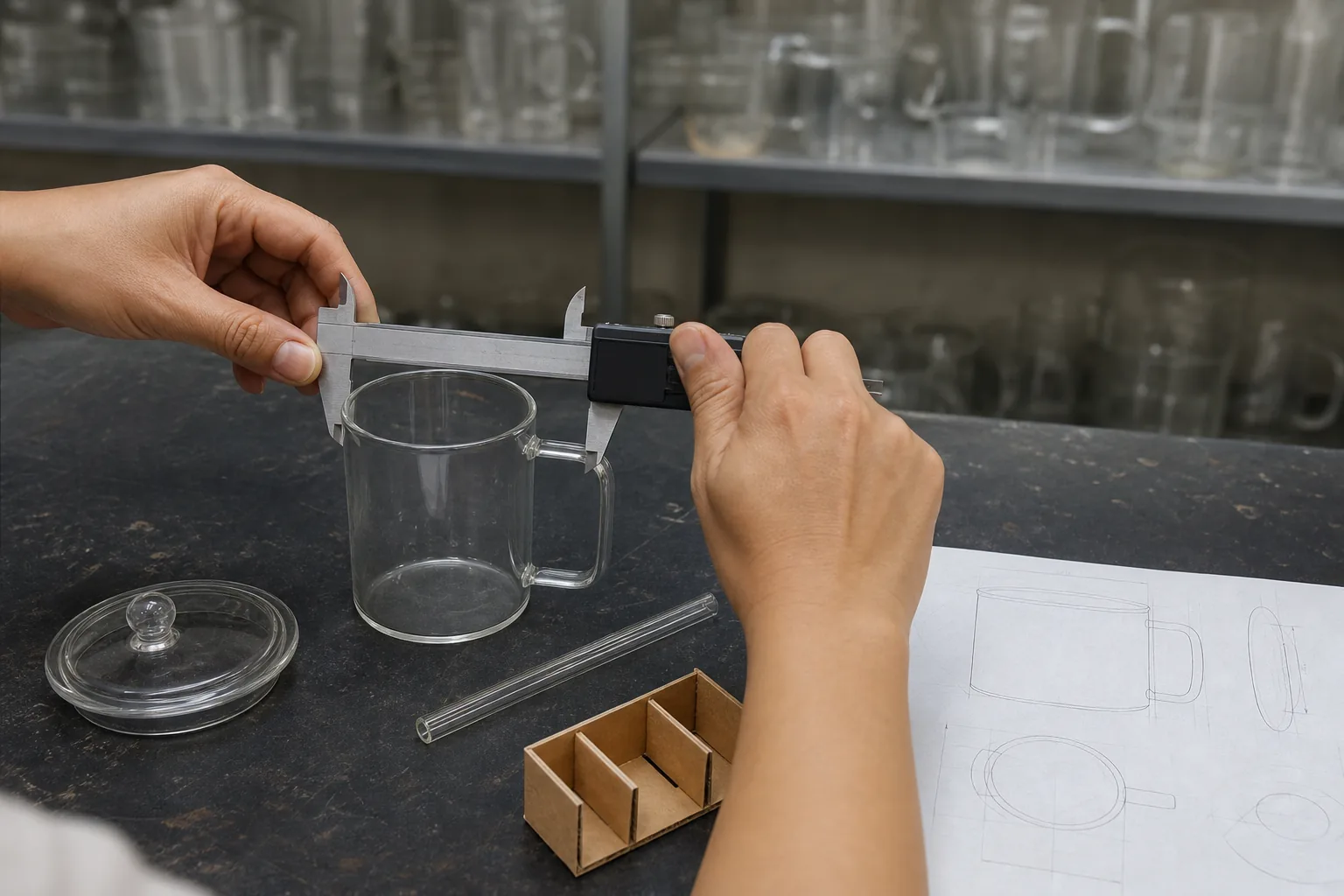
Editorial illustration. It visualizes the review step and is not presented as a photograph of a named customer order.
This is where a reference picture can become misleading.
Two cups may look almost identical on a phone screen but feel different in the hand. One may have a wider rim, a heavier base or a tighter handle. A lid made for one model may sit poorly on another. A logo that looks balanced in a mockup may appear too close to the rim on the real cup.
We prefer to identify these issues before a decorated sample is made. It is easier to adjust the model or artwork at the review stage than after the buyer has approved a visual rendering.
We separate the product into decisions
A clear glass cup project becomes manageable when we separate it into decisions.
For DB0003, the first decision is whether the existing 300ml borosilicate body is acceptable and how many pieces are required.
The second is decoration: handle Pantone reference, quantity per handle color, logo file, logo color, size, position and process.
The third is the selling unit: one cup, a selected color assortment or a six-piece set. If the reference includes an accessory not recorded in the basic scope, we identify it separately instead of assuming it is included.
The fourth is packaging: export packing, custom single box or six-piece set box, followed by the insert, label, barcode and carton marks required by the channel.
The fifth is approval: which physical samples or artwork confirmations the buyer needs before bulk production.
The last decision is shipment preparation: destination, trade term, required date and any warehouse or channel-specific instructions.
We do not expect a new buyer to know every answer in the first email. Our job is to show which decisions affect feasibility and price. The buyer’s job is to tell us which requirements cannot change.
For example, the target capacity may be fixed because it appears on retail packaging. The logo color may be fixed by a brand manual. The exact handle shape, however, may be flexible if an existing model can achieve the same use and price position.
That distinction helps us move quickly without guessing.
A digital mockup is useful, but it is not the final product
After the model and logo direction are clear, a digital mockup can help both teams confirm scale and placement.
It is a communication step, not proof of production quality.
A flat artwork file does not show how ink sits on a curved surface. It cannot fully represent glass reflections, small variations in wall thickness or the way a logo looks when the cup is filled. It also does not confirm whether the selected box protects the handle.
For a plain existing cup, the buyer may only need a standard sample. For a branded retail project, a decorated sample is more useful. If packaging is central to the sale, the buyer may also need a box sample or printed proof.
We discuss the approval route before the buyer pays for unnecessary samples. Sending every possible sample sounds safe, but it can add time without answering the key question. The right sample is the one that allows the buyer to approve the parts of the order that carry real risk.
Packaging changes how we judge the cup
Buyers often decide packaging after choosing the glass. We prefer to discuss it earlier.
The box affects more than appearance. It determines how the cup is supported, whether the handle touches the carton wall, how pieces are separated in a set and how many units fit in an export carton. It also affects labeling, barcode placement and the buyer’s warehouse plan.
DB0003 supplied for café or wholesale distribution may use practical dividers and a strong export carton. The same 300ml cup sold individually through e-commerce may need a custom single box and additional protection. A six-piece retail set needs an insert that keeps the colored handles and glass bodies from knocking against one another.
If packaging is left out of the first quotation, the buyer may receive an attractive unit price that does not describe the product they intend to sell.
That is why we ask for the sales channel at the beginning. We are not trying to design an expensive box for every order. We are trying to make sure the packing method matches the real journey of the cup.
Only then can we prepare a quotation we can explain
By this stage, the original message has changed completely.
It started with one photo and a request for the best price. It has become a defined DB0003 project with a 300ml borosilicate body, quantity per handle color, logo route, single or six-piece packing, sample plan and destination.
Now we can prepare a quotation with assumptions that the buyer can see.
If one decision is still open, we may present two routes. One could use the existing clear cup with a simple logo and export packing. The other could add a retail box or accessory. This allows the buyer to compare real finished products instead of comparing numbers that include different scopes.
We want the quotation, approved sample and purchase order to describe the same cup. When those three documents disagree, problems appear later as arguments about what was included.
The work we do before quoting is therefore not paperwork around the project. It is part of making the product.
What we need when you only have a photo
You do not need a complete technical drawing before contacting us.
If you have only a reference picture, send it. Then add whatever you already know:
- DB0003 as the starting SKU, or the target capacity if 300ml is not suitable
- Intended use and sales channel
- Expected trial and repeat quantity
- Whether a similar existing model is acceptable
- Pantone reference per handle color and quantity per color
- Logo file or branding idea
- Lid, straw or other accessories
- Individual packing or set-packing idea
- Destination country
- Target timing
If something is undecided, mark it as open. That is more useful than choosing an answer only to complete a form.
We can then tell you which existing cups are close, what must be sampled, which choices change MOQ and what information is still needed for a quotation.
Questions buyers ask us at this stage
Can we start a glass cup project with only a photo?
Yes. Send the photo together with the approximate capacity, expected quantity, sales channel and destination. We can use that information to look for an existing model and identify the decisions that remain open. A photo is enough to start a discussion, but not enough to confirm a final price.
Does every reference photo require a new mold?
No. For a colored-handle 300ml reference, we first check DB0003 against the required use, proportions and market position. A new mold makes sense only when the unique shape creates enough commercial value to justify drawings, tooling, trials and additional approval work.
Which sample should a buyer approve?
It depends on the risk in the project. A standard sample can confirm shape and hand feel. A decorated sample can confirm logo scale and placement. A box sample or printed proof becomes important when packaging is central to the retail offer.
What usually changes the MOQ?
For DB0003, the planning baseline starts from 2,000 pieces. The number of handle colors, quantity per color, decoration process, custom packaging and SKU split can change the practical MOQ. We review those parts separately before confirming the order route.
The best first inquiry is not the longest one
A useful inquiry does not need ten attachments and a finished specification.
It needs a clear product idea, a realistic quantity and an honest explanation of how the cup will be sold. From there, we can ask focused questions instead of sending a generic price list.
When you send us a colored-handle glass cup photo, we first ask whether DB0003 can become the base product. Then we align the handle colors, logo, set combination, box, sample and shipment around that actual cup.
Our work is to turn those decisions into one product the buyer can approve and reorder.
If you are at the photo stage, send us the reference, expected quantity, handle colors and destination. We will compare it with DB0003 and tell you whether the existing 300ml model can support the project or whether another cup should be considered.