
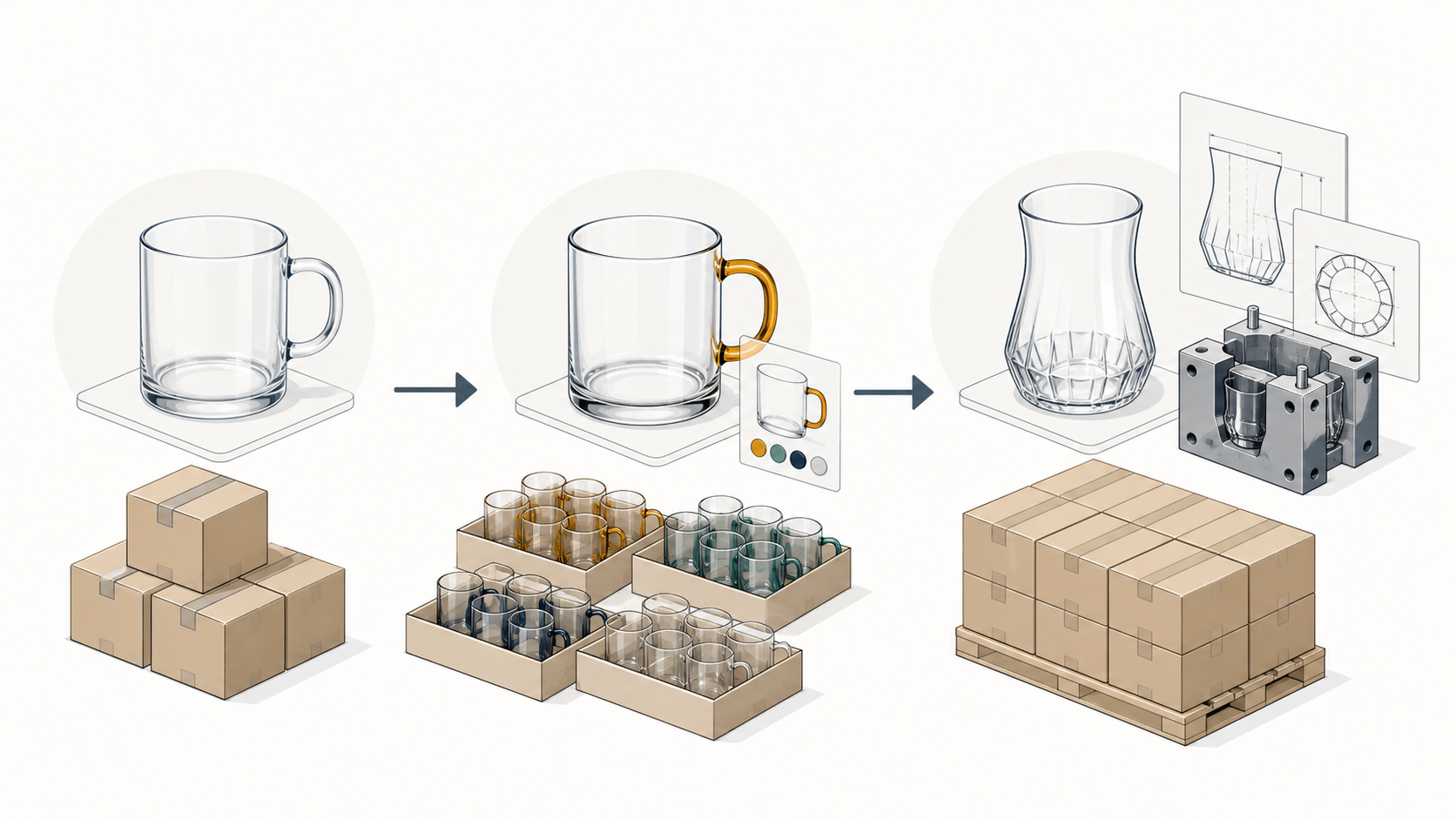
“What is your MOQ?” looks like a question that should have one short answer.
Our common planning baseline for many OEM glassware projects starts from 2,000 pieces. That is useful for an initial budget, but it is not the full answer. The workable minimum for a real order depends on the glass model, capacity, color split, decoration, accessories, packaging and number of finished SKUs.
We have seen buyers compare suppliers using only the headline MOQ and later discover that one price covered a plain glass in bulk packing while another covered a logo, lid, color box and several colors. The two numbers were not describing the same order.
This guide explains how we review glassware MOQ from the supply side and how a buyer can plan a smaller first assortment without building a fragile or expensive production plan.
MOQ is the smallest complete production plan, not the smallest number we can type
For us, an MOQ is workable only when the materials, forming route, decoration, accessories, packing and inspection can be organized as one controlled order. A single total quantity can hide many smaller batches.
Consider a buyer asking for 2,000 cups. If all 2,000 use one existing clear body, one logo and one box, the plan is relatively direct. If the same total is divided among four capacities, five handle colors and two logos, it becomes many small production and packaging groups. Each group must be identified, decorated, counted and packed correctly.
The glass quantity is only one layer. A printed box supplier may have its own efficient run size. A special lid or silicone part may require a separate purchase. A new color needs approval and production control. A custom mold creates a development route before bulk output begins.
That is why we ask for the SKU breakdown before confirming the MOQ.
Route one: an existing model with limited variation
The most practical route for a first order is often an existing model. The buyer selects a current cup, pitcher, teapot or jar, then limits the first project to a clear specification.
For example, DB0003 is an existing 300ml borosilicate glass cup with a colored handle. Its current planning baseline starts from 2,000 pieces. If the buyer accepts the body, chooses one or two handle colors, uses one logo and confirms one pack format, we have a defined project to review.
See the current DB0003 colored-handle glass cup.
The phrase “starts from 2,000 pieces” still does not mean unlimited color splitting. We need the quantity per handle color and the set combination. A six-piece mixed-color box creates different counting and insert requirements from single-color bulk packing.
Existing models reduce product-development work, but they do not remove the need to confirm decoration and packaging. They simply give both sides a real glass body to measure and sample.
Route two: decoration and accessories create their own minimums
A plain glass and a finished private-label item are not the same SKU.
Logo printing, decals, color coating or other decoration requires setup and an approved sample. Multiple artwork versions divide the run. A lid, straw, sleeve, stainless infuser or wooden component adds another supply line. If the accessory color changes, the order may be divided again.
For a glass teapot, the glass body may be available in 400ml and 600ml, but the buyer still has to choose the infuser, lid, logo and gift-box direction. For a double-wall cup range, 250ml, 350ml and 450ml sizes may look like one family, yet every capacity requires its own quantity and box fit.
We therefore ask these questions:
- How many glass body models and capacities are required?
- How many colors will be produced, and how many pieces per color?
- How many logo files or logo colors are involved?
- Which accessories belong to each SKU?
- Will every item use the same pack structure?
- Is the order one shipment or several destination-specific lots?
When the answers are clear, we can identify which part of the order sets the practical minimum.
Route three: a new mold changes the conversation
A buyer sometimes expects a new shape at the same MOQ and lead time as a catalog product. From our side, the new mold is a separate development project.
We first review the drawing, target capacity, forming feasibility, key dimensions and intended use. Then tooling, trials and sample approval have to happen before bulk production. The economics of the order must support that work.
We do not suggest a new mold only to make a quotation look more customized. It makes sense when the shape creates real product value: a protected brand silhouette, a functional improvement, a required dimension or a collection that the buyer plans to reorder. If a current model can meet the use and most of the visual goal, we show that route first.
This distinction matters when comparing MOQ. An existing model with decoration and a new molded body may share a product name, but they are not equivalent production plans.
Printed packaging can become the hidden MOQ
Packaging is often the last detail buyers send and the first reason a low-quantity project becomes expensive.
A plain export carton, a custom single color box and a rigid gift set require different materials and setup. Printed boxes must be made in the right size. Inserts must fit handles, spouts, lids and accessories. Several language versions or barcode versions divide the packaging quantity even when the glass is identical.
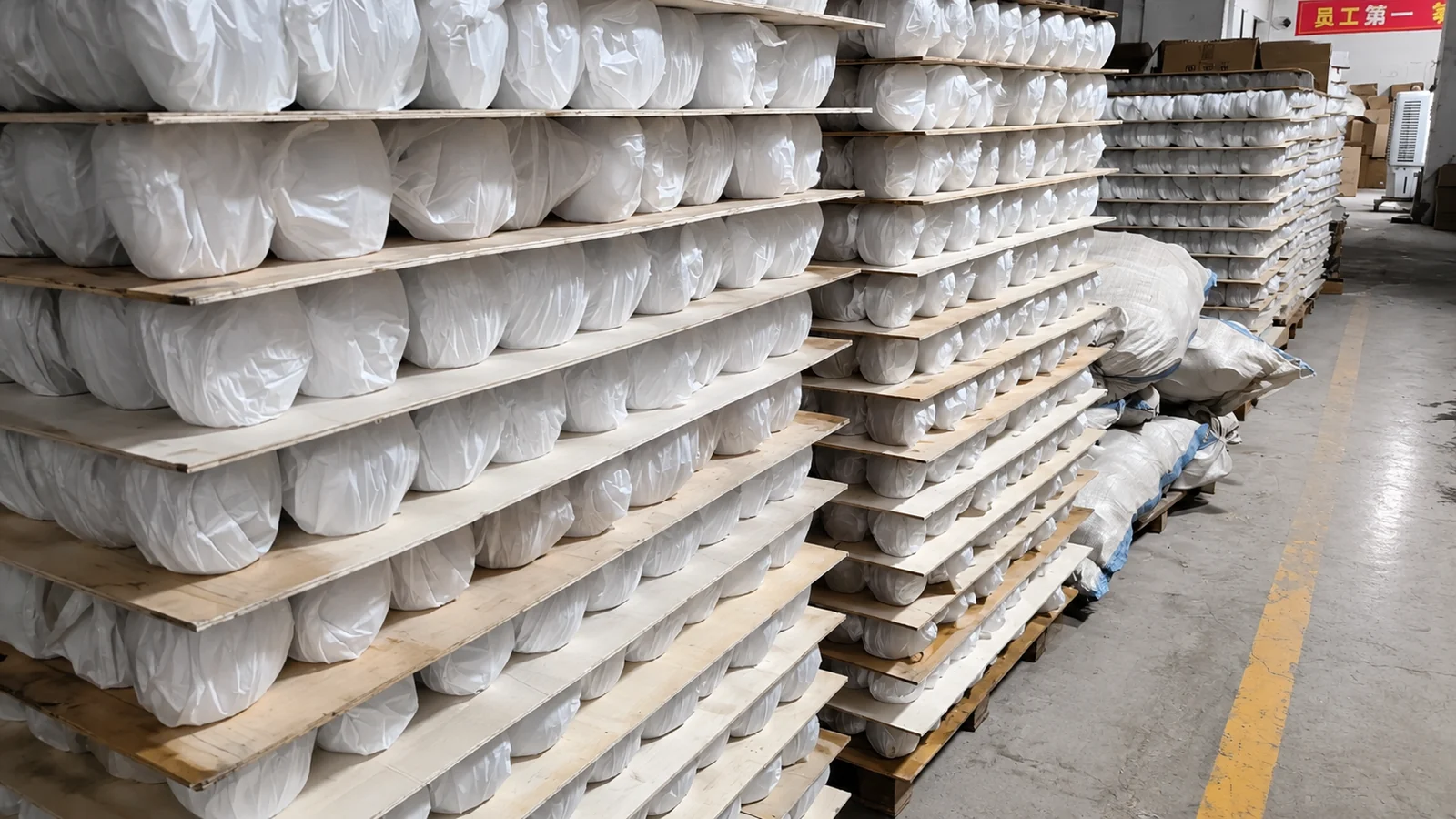
Real Guangyi Glass supply-side staging. Individual protection and orderly separation are part of the production and packing workflow.
For a trial order, we may recommend a standard protective structure with a simpler label or sleeve instead of several fully printed box versions. The right answer depends on the sales channel. A retail buyer needs shelf information. An e-commerce seller needs parcel protection. A hospitality buyer may prioritize safe bulk handling over a presentation box.
Review our retail and export packaging options.
How we help buyers simplify a first order
A low-risk trial order is not simply a large assortment made smaller. It is a focused assortment designed to answer a commercial question.
If a buyer wants to test demand, we may recommend one existing shape, one or two capacities, fewer colors, one logo file and one packaging route. This keeps the product recognizable while reducing small production groups. The buyer can learn which capacity or color sells before adding the next SKU.
We also distinguish sample quantity from bulk MOQ. A sample lets the buyer check a product or decoration. It does not prove that the same unit cost applies to a small bulk run. Sample work and bulk production are planned differently.
For current catalog projects, a typical sample planning range is 7–15 days after the product, logo, accessories, pack scope and destination are confirmed. The final bulk timeline is quoted only after sample and order details are approved. We do not publish one universal production promise for all glassware.
Why a very low MOQ can create a misleading unit price
Some setup work exists whether the run contains a few pieces or many. Artwork checking, decoration setup, packaging development, carton marks, sample approval and inspection planning do not disappear in a small order. When those costs are spread over fewer finished units, the unit price rises.
Shipping can also distort the comparison. A small glassware shipment has a large volume relative to its value and still needs protective cartons. Buyers should compare the total landed project, not only the supplier unit price. Destination, carton dimensions, freight mode and local charges all matter.
We would rather show two clear routes than hide these differences. One route may use an existing model, limited decoration and practical packing. Another may use a fully customized box and a broader assortment. The buyer can then decide which version fits the test budget.
QC does not become optional because the order is small
A trial order still needs a defined approval standard. We check the product against the confirmed model and sample, including dimensions or capacity where relevant, rim and finish, handle or accessory fit, decoration, set count and carton protection.
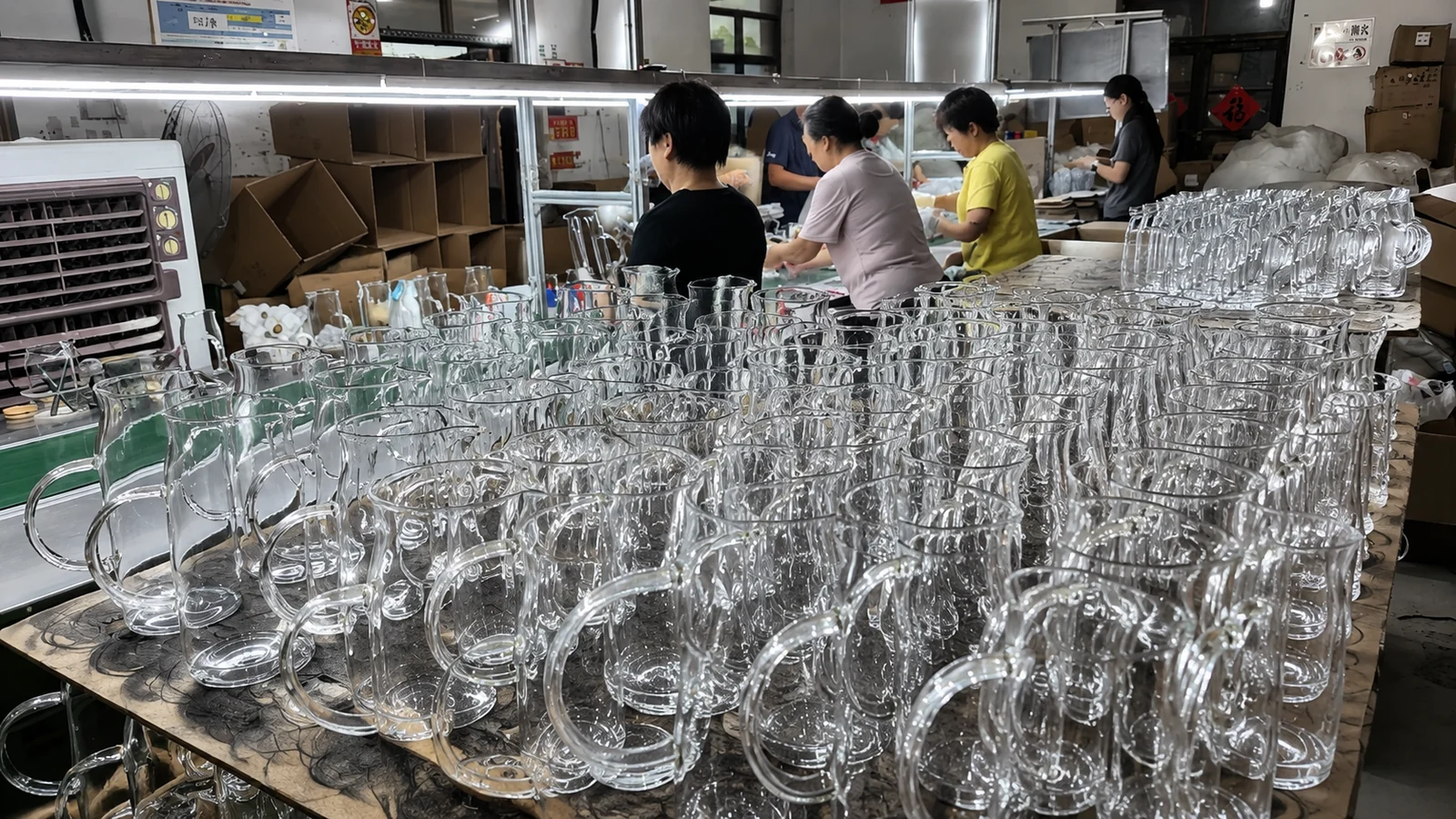
Real Guangyi Glass inspection imagery. It illustrates the QC workflow, not a claimed order for a named buyer.
Small orders can be more sensitive to errors because there are fewer spare units and more SKU splits. If four colors are packed into one set, count accuracy is essential. If one accessory is missing, the finished retail item is incomplete even when the glass itself is acceptable.
See our glassware QC checkpoints.
Information we need before confirming your MOQ
Send a short, specific brief:
- Product link, SKU, drawing or reference photo
- Target material and capacity
- Total order quantity
- Quantity per size, color and logo version
- Required lid, straw, infuser, sleeve or other accessories
- Retail, gift, e-commerce or bulk pack requirement
- Destination country or warehouse
- Target delivery or launch date
We can then identify the existing-model option, the variations that divide the order, the sample needed and any packaging or accessory minimum that affects the plan.
Send your project details to our order team.
Buyer FAQ
What is the normal MOQ for Guangyi Glass OEM orders?
Our common planning baseline for many OEM glassware projects starts from 2,000 pieces. The final MOQ depends on the selected product, quantity per variant, decoration, accessories and packaging. We confirm it after reviewing the full SKU breakdown.
Can I split 2,000 pieces into several colors?
Sometimes a color split is workable, but it is not automatic. Send the number of colors and quantity per color. Small color batches may affect production setup, consistency, counting, packing and cost.
Can I order below the stated MOQ for a market test?
We can review the request, especially when it uses an existing model and limited customization. We cannot promise that every project can run below the planning baseline. Simplifying capacities, colors, logos and printed packaging usually creates the most realistic trial route.
Does a custom logo change the MOQ?
It can. The process, number of logo versions, logo colors and quantity per version affect setup and production grouping. A simple single logo is easier to organize than several small artwork batches.
Does custom packaging have a separate MOQ?
It may. Printed boxes, inserts and labels have their own efficient production quantities. We review the glass and packaging together so the buyer understands the complete finished-item minimum.
Is sample quantity the same as bulk MOQ?
No. A sample is made for product, decoration or packaging approval. Bulk MOQ describes the smallest workable production order and has a different cost structure.
What is the best way to reduce MOQ risk?
Start with an existing model, a focused capacity range, fewer colors, one logo and one pack structure. Use the first order to learn which SKU deserves a repeat order before expanding the assortment.
Ask us for a workable order plan
Guangyi Glass supplies custom glass cups, pitchers, teapots, storage jars and export packaging for overseas B2B projects. We do not confirm MOQ from a product name alone.
Send the closest model, total quantity, variant split, logo, accessories, packaging and destination. We will explain which part of the project controls the minimum and which changes could make the first order easier to produce and repeat.
Send your glassware project for MOQ review or browse current glassware models.