
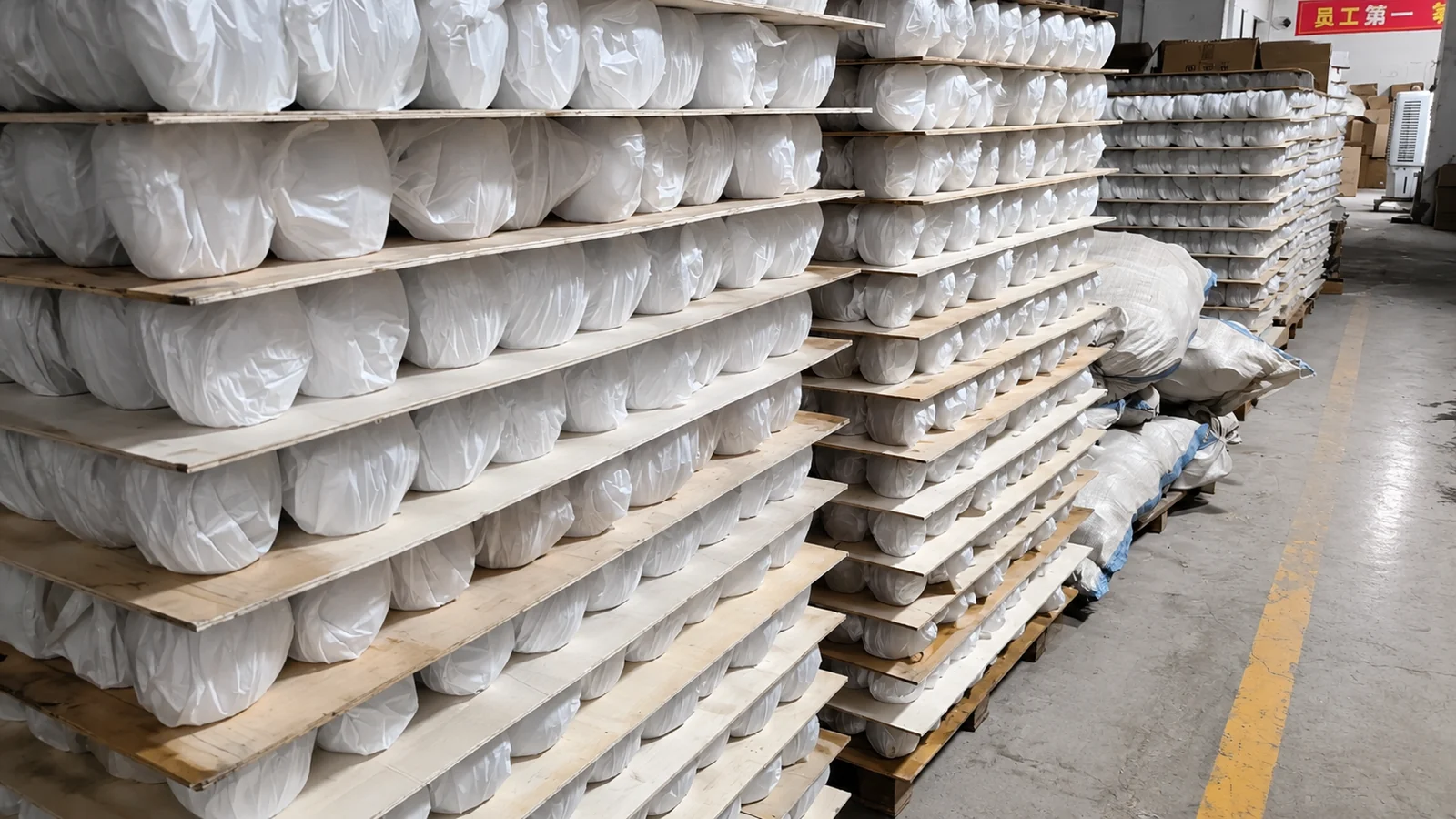
Glassware packaging is not a box selected after the product is finished. It is part of the product specification.
We have seen buyer briefs that describe the glass in detail but use only two words for the pack: “safe packaging.” That phrase does not tell us whether the product will be sold in a retail store, delivered individually by courier, supplied in bulk to a restaurant or presented as a gift set. Each route exposes the glass to different movement and requires a different structure.
From our supply-side review, export packaging begins with the approved product, its weakest points and the journey after production. We define what must be protected, how pieces are separated, how accessories are counted and how the finished units enter the export carton. The right pack is not always the most expensive one. It is the one that matches the glass, sales channel and transport path.
We ask where the package will go after import
A retail box may travel inside an export carton to a distributor, then move to a store shelf. An e-commerce product may leave the importer’s warehouse as one parcel and experience another handling cycle. Hospitality glassware may be removed from a bulk carton and sent directly into service. A gift set must protect several components while also presenting them in a fixed order.
These are not interchangeable routes.
For retail, the buyer may need artwork, barcode, product information, country mark and a box that displays well. For e-commerce, the retail box may need additional outer protection because shelf packaging alone is not designed for repeated courier drops. For restaurant or hotel orders, an efficient divider and strong carton may be more useful than a printed individual box.
We ask for the destination country and warehouse route before the packaging quote. That helps the buyer compare the cost of a complete delivered product rather than a glass-only unit price.
We identify the weak points on the approved product
Every shape creates its own packing risks.
A cup handle can touch a box wall. A pitcher has a projecting spout and carries more mass. A teapot combines a handle, spout, lid and infuser. A glass jar may include a wood, bamboo, silicone or metal lid. A double-wall cup needs support without concentrated pressure on the body or rim.
Accessories introduce another risk: movement. A loose lid, straw, spoon or stainless infuser can contact the glass during transport. A beautiful gift set can arrive incomplete if small parts are not counted and held in defined positions.
We therefore freeze the complete selling-unit list before confirming the insert. The box drawing should be built around the actual approved sample or reliable final dimensions, not around an early product estimate.
Retail box and export carton have different jobs
The retail box communicates and organizes the item. The export carton groups finished units for transport. One does not automatically replace the other.
A custom retail box may carry the buyer’s artwork, barcode and instructions. It can include an insert that holds the product in the right position. But a thin display box may still need a stronger outer carton and internal arrangement for export.
The export carton must account for the inner quantity, packed dimensions, total weight, stacking and agreed marks. If pallets are required, that request should be known before the final loading plan. Freight cost is influenced by the packed volume, not the dimensions of the bare glass.
Review our current retail and export packaging options.
Dividers and inserts solve different problems
A divider separates multiple pieces inside a carton or set. An insert holds a product and its accessories in defined positions. Both can be made in different structures and materials depending on the project.
For a six-piece cup set, dividers may prevent glass-to-glass and handle-to-glass contact. For a teapot gift set, a shaped insert may be needed around the body, lid, infuser and cups. For a pitcher, the structure must leave room around the spout and handle while controlling the larger body.
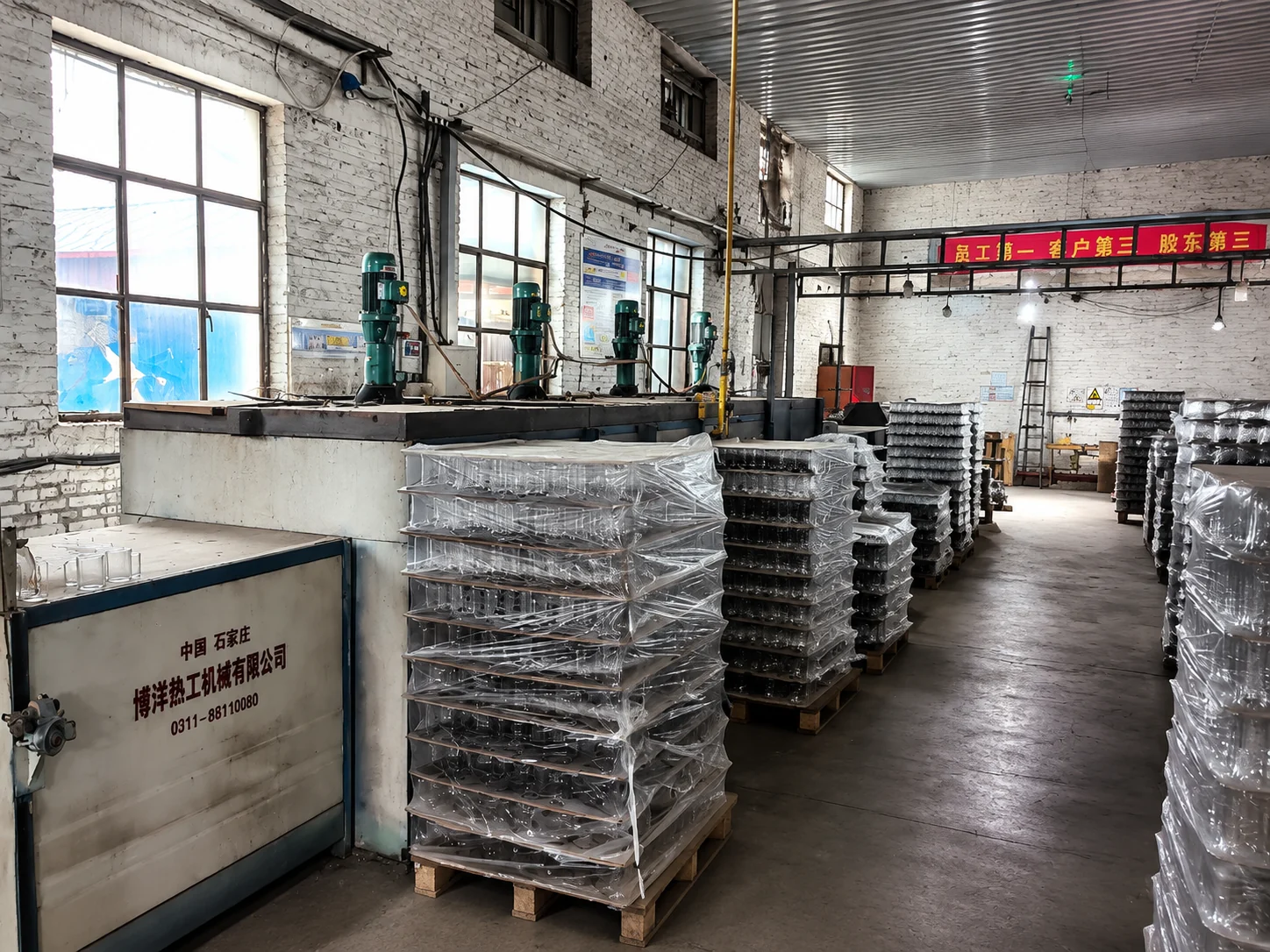
Real Guangyi Glass workshop imagery. Organized trays help keep products separated and identifiable during production handling.
The insert should support the product without creating excessive pressure on a rim, handle joint or other vulnerable area. We review it with the actual component set. A neat computer rendering is not enough if the physical sample moves or is difficult to pack consistently.
Packaging must be included when the sample is approved
Many buyers approve the glass sample first and start discussing the box just before production. That timing creates avoidable risk.
The box affects the finished product cost, carton dimensions, freight volume and production schedule. Printed artwork and inserts also require their own approval. If the buyer changes the set count or adds an accessory, the old box drawing may no longer work.
We separate the approvals:
- Product sample: shape, capacity, finish, logo and accessory fit
- Packaging proof or sample: artwork, dimensions, insert and piece arrangement
- Export-carton specification: inner count, strength direction, dimensions and marks
All three should refer to the same final SKU. The approved files and samples form the packing standard for production.
Custom packaging can affect MOQ and unit cost
A plain export carton, a printed single box and a premium gift box have different production economics. Printed packaging may have its own practical minimum. Several languages, barcodes or retailer versions divide the quantity even if the glass body is identical.
For a trial order, we often discuss whether one standard protective structure can support a simpler label or sleeve. That can be more realistic than producing several small custom-box runs. The buyer should still receive a pack that matches the channel; simplification should not remove essential protection or required information.
Our general planning baseline for many OEM glassware projects starts from 2,000 pieces, but packaging and variant splits can change the finished-item minimum. We confirm the total quantity and quantity per box version before finalizing the route.
Read how packaging and SKU splits affect glassware MOQ.
E-commerce requires another level of thinking
A product that survives grouped export transport may still be vulnerable when shipped alone from a fulfillment center.
In a master carton, neighboring units and the outer carton form one transport system. After import, an e-commerce unit may be removed and placed into a courier parcel with empty space or mixed items. Repeated sorting and last-mile handling create a different risk.
We ask whether the buyer’s warehouse adds its own shipping carton and cushioning. If not, the retail package may need additional protection. The buyer should test the complete parcel configuration used in the market, not only the specified export carton.
We avoid claiming that one package is universally “drop proof.” Test methods, sample condition and acceptance criteria must be defined for any formal claim. Our role is to prepare and inspect the agreed structure, then support the buyer’s required verification plan.
Labels and carton marks are part of accuracy
Breakage is not the only packaging problem. A correct product can be sent to the wrong warehouse or received as the wrong SKU if identification is unclear.
We ask the buyer to confirm barcode files, SKU names, quantity per box, carton marks, destination marks and any retailer labels. If several colors or capacities share similar boxes, the visible identification must be unambiguous.
The team checks piece count and pack version during production. A mixed-color set must contain the approved assortment. A spare lid or infuser should not be confused with the main selling unit. Good packaging supports traceability as well as protection.
Our packing QC follows the approved specification
Before shipment, we check that the pack matches the approved product and files. Typical review points include product orientation, individual protection, accessory count, divider or insert fit, retail-box version, inner quantity, export-carton condition and carton marks.
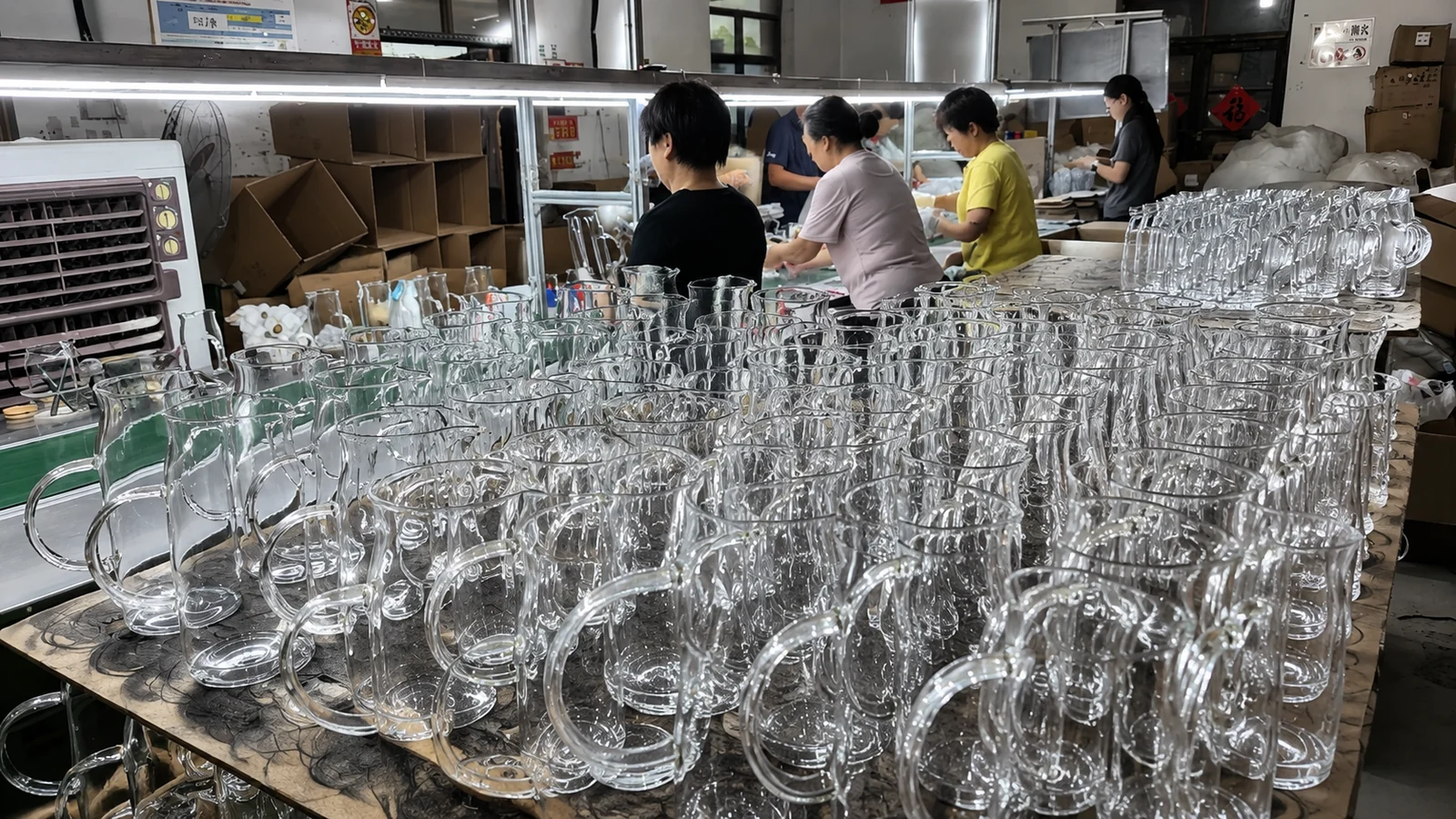
Real Guangyi Glass supply-side inspection imagery. It illustrates the working environment without presenting a confidential buyer order.
For pitchers and teapots, we pay attention to handle, spout, lid and filter protection. For cup sets, we check separation and count. For double-wall cups, we avoid unsupported pressure points. If a pack revision is approved, the new version must replace the old instruction clearly.
What to send for a packaging review
Send the packaging request together with the product inquiry:
- Product link, SKU, drawing or approved dimensions
- Complete list of glass and accessory components
- Quantity per selling unit and per SKU
- Sales channel: retail, gift, e-commerce, hospitality or bulk
- Existing box artwork, barcode and label requirements
- Preferred box direction or reference
- Destination country and warehouse route
- Pallet request, if applicable
- Required delivery or launch date
If the final box is not yet designed, we can still review the product risks and identify the information needed for a packaging sample.
Buyer FAQ
What is the difference between retail packaging and export packaging?
Retail packaging presents and identifies one selling unit. Export packaging groups and protects finished units during international transport. A retail box may still need an insert, master carton and additional e-commerce protection.
Can Guangyi Glass provide custom color boxes and gift boxes?
We can review custom color boxes, gift boxes, inserts, dividers, labels, carton marks and export cartons. The final structure is based on the approved product, set contents, quantity and destination.
When should packaging development begin?
Begin while the product and accessory list are being confirmed. Final dimensions should follow the approved item, but the sales channel, set count and box direction should be included in the first RFQ.
Does custom glassware packaging have an MOQ?
It can. Printed boxes and inserts have practical production quantities, and several artwork or barcode versions divide the run. We review the package together with the glassware MOQ.
Is a gift box enough for e-commerce shipping?
Not automatically. A shelf-ready gift box may need another parcel-protection layer. Buyers should test the actual single-unit shipping configuration used by their warehouse or fulfillment partner.
What information goes on an export carton?
The exact marks are confirmed with the buyer. Common inputs include SKU or item identification, quantity, destination or consignee marks and handling information required by the project. We do not invent marks without buyer approval.
How do you reduce glass-to-glass contact?
We use suitable individual protection, dividers or inserts based on the product shape and set count. The physical pack should be checked with the approved glassware and accessories.
Treat the pack as part of the RFQ
Guangyi Glass plans glass cups, pitchers, teapots, jars and their retail and export packaging for overseas B2B orders. A useful quote describes the finished packed item.
Send the product, component list, quantity, sales channel, box direction and destination. We will identify the weak points, the required sample or proof and the packing details that affect MOQ, carton volume and shipment readiness.
Request a glassware packaging review or read our other glassware sourcing guides.