
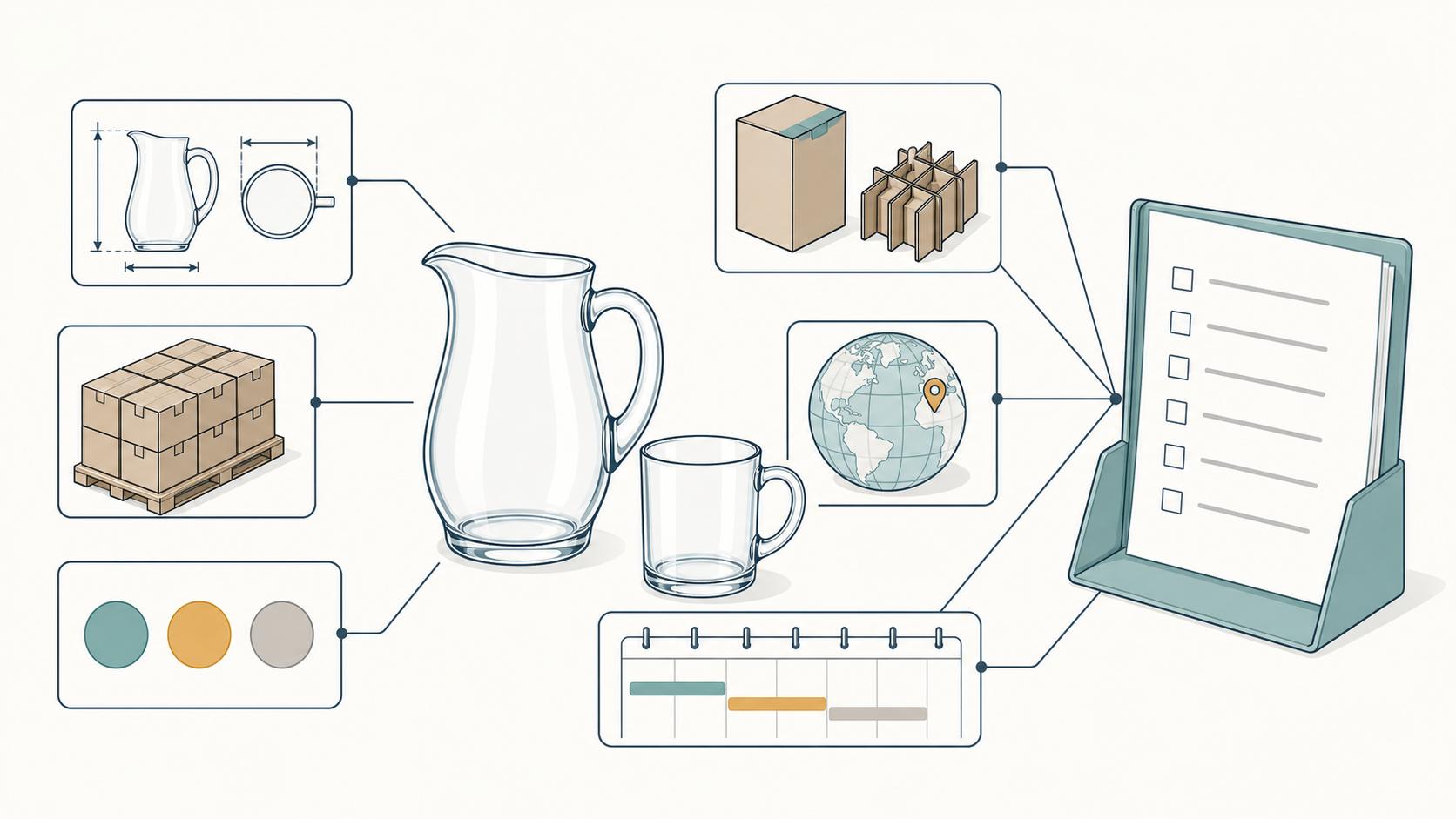
A good glassware RFQ does not need to be long. It needs to make the finished product visible.
The most difficult inquiries are not always the short ones. A message can contain many attachments and still leave out the quantity per size, the accessories included in one selling unit or the destination. When those details are missing, the supplier has to fill the gaps with assumptions. The buyer then receives prices that appear comparable but describe different products.
From our supply-side review, the most useful first RFQ identifies the product, capacity, quantity, customization, packaging, destination and required date. If some decisions are open, say so. We can recommend an existing-model route and explain what needs sample approval.
This guide gives overseas buyers a practical glassware RFQ structure that works for cups, pitchers, teapots, storage jars and sets.
1. Identify the closest product
Start with a product link, SKU, drawing or reference image. If you found an item in our catalog, use its SKU because it connects the inquiry to a real model.
For example, DB0003 identifies a 300ml borosilicate cup with a colored handle. SH1022 identifies a current 1800ml borosilicate cold-water pitcher with a 304-stainless-steel direction. KFH5000 identifies a 400ml and 600ml glass teapot family with a stainless infuser. DBS0031 identifies a 250ml, 350ml and 450ml double-wall cup family.
The SKU does not close every decision, but it gives us a known body, capacity range and current customization route. If your reference is from another source, tell us which features must be similar and which can change. Do not assume that a photograph contains enough information to copy dimensions or material.
Browse our current glassware product categories.
2. State the intended use and sales channel
Tell us what the product will do and where it will be sold.
A café merchandise cup, a six-piece retail set, a restaurant pitcher and an e-commerce gift item need different accessories, decoration and packing. A glass teapot for loose-leaf brewing requires a clearer infuser specification than a serving pot. A jar for a dry-food range needs a lid and label plan.
Useful descriptions include:
- Café merchandise cup for hot and iced drinks
- Six-piece colored-handle cup set for homeware retail
- 1.8-liter refrigerator pitcher with lid and filter
- Teapot and two-cup gift set for a tea brand
- Single-unit online sale shipped through a fulfillment warehouse
- Bulk glassware for restaurant or hotel service
The intended use also alerts us to claims that need confirmation. We do not infer dishwasher, microwave, oven, stovetop or thermal performance from appearance alone. Tell us which use statements your market needs so they can be reviewed against the selected product and evidence.
3. Give the capacity and critical dimensions
Capacity affects the product body, user experience, pack size and freight volume. Write the target in milliliters or liters and say whether it is fixed or approximate.
If a dimension matters to fit a refrigerator door, coffee machine, cup holder, shelf or existing lid, include it. A simple marked-up image is useful. For a set, list the capacity of every component.
Avoid asking for “the same size as the photo.” Perspective can distort proportions, and many online images do not identify the usable capacity. We compare the reference with current samples and dimensions, then tell you which model is closest.
When several sizes are involved, list the quantity for each. Capacity ranges are not one production SKU.
4. Show total quantity and the complete variant split
“2,000 pieces” is not enough when the order contains several colors, capacities or logos.
Write the total, then break it down. For example:
- 1,000 pcs, 300ml, amber handle, logo A
- 1,000 pcs, 300ml, teal handle, logo A
- Packed as one amber plus one teal cup per two-piece set
That description lets us review production grouping and set count. The same total divided into eight colors would be a different plan.
Our common planning baseline for many OEM glassware projects starts from 2,000 pieces. Final MOQ depends on the product model, quantity per variant, decoration, accessories and packaging SKU. If your target is lower, state it honestly. We can check whether an existing model and a simplified assortment provide a workable trial route.
Read our complete explanation of glassware MOQ.
5. Define the logo and visible customization
Attach a vector logo if available. State the preferred color, approximate size, position and process if you already know it. If you do not know the process, tell us the desired appearance and use condition.
For color projects, provide a Pantone reference or another controlled standard and the quantity per color. For a pitcher, teapot or cup set, indicate which side should face the customer on a shelf. For several capacities, decide whether the logo should have the same physical size or the same visual proportion.
Avoid sending only a low-resolution screenshot. A clear artwork file reduces sampling errors. The approved decorated sample or documented proof should control bulk production.
If the box also uses the logo, treat the glass artwork and packaging artwork as separate files and approvals.
6. List every accessory in one selling unit
A lid, straw, sleeve, spoon, infuser or spare component changes the product. Write the exact quantity of each accessory per unit or set.
For a pitcher, specify lid material and whether a filter is included. For a teapot, specify the lid and infuser rather than writing only “tea set.” For a cup, state whether a lid or straw is required and whether it must match a color. If replacement components are needed, list them separately.
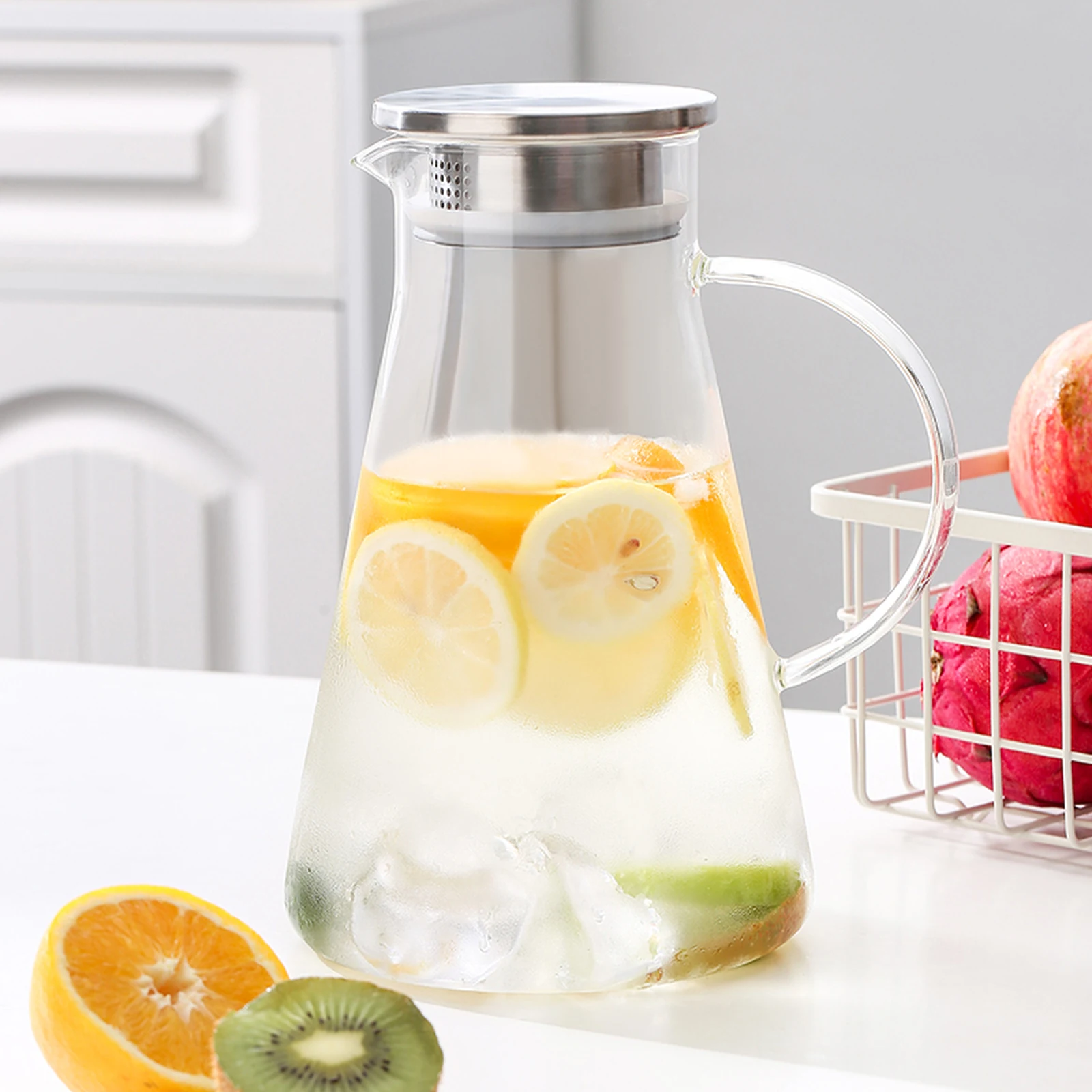
Real Guangyi Glass SH1022 product imagery. Accessory specifications are confirmed with the selected product and sample.
Accessories have their own fit, count and packaging risks. A quote should state what is included so the buyer does not compare a glass-only price with a complete-item price.
7. Describe the packaging and sales unit
Tell us how the buyer will receive and sell the product:
- Bulk divided export carton
- Individual plain or custom color box
- Pair or multi-piece retail set
- Gift box with insert
- E-commerce pack for single-unit delivery
- Hospitality pack with practical dividers
State the pieces per set and any barcode, label, country mark or carton-mark requirements. Attach box artwork or a reference if available.
Packaging should be developed around the approved glass and accessories. It affects the finished unit cost, carton dimensions, freight volume, MOQ and schedule. A retail box does not automatically provide enough protection for last-mile parcel delivery.
See how we plan glassware export packaging and review our packaging capabilities.
8. Add destination, trade basis and delivery target
We need at least the destination country or warehouse city to understand the shipment context. If you want an FOB, EXW, DDP or another trade basis reviewed, state it. Freight and local charges change over time, so the destination and quotation date matter.
Provide the date when the goods are needed and explain whether it is a warehouse arrival date, shipment date or retail launch. These are not the same milestone.
We plan backward from approved samples and artwork through bulk production, inspection, packing and dispatch. A current catalog sample commonly takes 7–15 days after the key decisions are clear. Bulk timing depends on the approved project and order schedule; we confirm it in the quotation rather than making one universal promise.
Seasonal and promotional projects should include the non-negotiable launch date in the first message. Late packaging artwork is a common reason an apparently simple order loses time.
9. Explain what the sample must prove
Do you need a plain current sample to check size and hand feel? A decorated sample to approve the logo? A complete set to check component fit? A packaging sample to approve the insert and box?
State the sample purpose. It helps us prepare the right item and avoid sending a plain product when the real risk is the logo or packaging.
The buyer should record the approved version, including product model, capacity, decoration file, accessories and pack. Production instructions should not rely on scattered messages after approval.
10. Include QC or compliance requirements that are real
If your company has an inspection checklist, required test method, retailer manual or destination-specific document, send it early. We can review what applies to the selected product.
Do not ask a supplier to “provide all certificates” without naming the market and product claim. Different materials, coatings, accessories and uses may require different evidence. We will not invent certifications or apply an unrelated report to a new item.
Our product QC normally reviews points such as glass finish, rim, capacity or dimensions, handle or accessory fit, decoration, set count and carton protection. Product-specific items include pitcher pouring and lid fit, teapot spout and infuser fit, or double-wall inner and outer wall appearance.
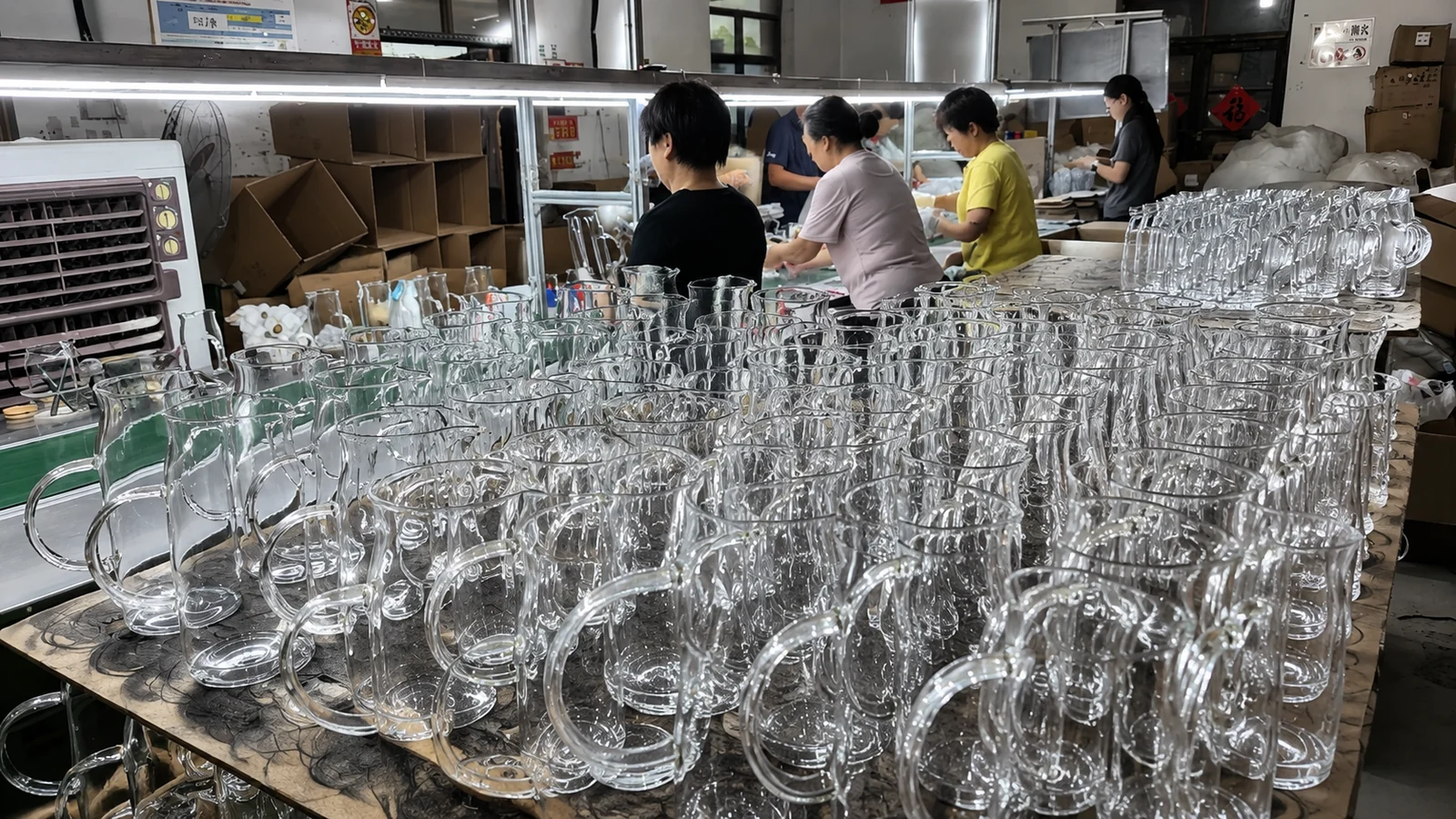
Real Guangyi Glass inspection imagery. It demonstrates a supply-side QC environment without claiming a named customer project.
Review our glassware quality-control approach.
Copy this short glassware RFQ template
You can send this in an email, form or WhatsApp message:
Product or SKU:
Intended use and sales channel:
Capacity and critical dimensions:
Total quantity:
Quantity per size, color and logo:
Material or use requirements:
Logo file, color, size and position:
Lid, straw, infuser or other accessories:
Pieces per set:
Retail, gift, e-commerce or bulk packaging:
Destination:
Preferred trade basis:
Required shipment, arrival or launch date:
What the sample must prove:
Required QC or test document:
You do not need to complete every line before contacting us. Mark unknown decisions as open. That is better than letting each supplier make a different assumption.
Buyer FAQ
What are the minimum details needed for a glassware quotation?
Send the product or closest reference, capacity, total quantity and variant split, logo, accessories, packaging, destination and target date. Those details let us define the finished product.
Can I request a quote using only a reference photo?
Yes, as a starting point. Add target capacity, expected quantity, use, packaging and destination. We will compare the photo with current models and identify missing specifications before confirming the final quote.
Should I ask for FOB, EXW or DDP pricing?
State the trade basis you use and the destination. If you are unsure, tell us where the goods need to reach so the available quotation routes can be discussed. Freight-related prices are time-sensitive.
Do I need finished box artwork before requesting a quote?
No. State the box type, pieces per set, sales channel and destination. Artwork can follow, but packaging scope must be included in the initial estimate because it affects cost and schedule.
How do I request a low-MOQ trial order?
Give your real target quantity and accept that the assortment may need simplification. An existing model, fewer colors, one logo and one pack route usually create the most practical review.
What file should I send for a logo?
A vector file is preferred when available. Also state the logo color, approximate size and position. A decorated sample or documented proof should be approved before bulk production.
How quickly can I receive a sample?
For many current catalog projects, 7–15 days is a typical planning range after the model, decoration, accessories and packaging scope are confirmed. New tooling or complex packaging can take longer.
Send one defined project and receive one understandable quote
Guangyi Glass reviews glass cups, pitchers, teapots, storage jars, accessories and packaging for overseas B2B buyers. We do not need a perfect specification before the first conversation, but we do need honest information about the order.
Use the template above and send the closest SKU, quantity, customization, pack and destination. We will show which details are already workable, which assumptions need approval and what sample route can move the project forward.